The History of the Dala Horse: Sweden in Carved and Painted Wood
June 11, 2026 · Sweden's Finest
Few objects say Sweden as instantly as the Dala horse. Squat, sturdy, and almost always a deep glowing red, the little wooden horse — the dalahäst — stands on windowsills and mantelpieces around the world as a small ambassador of Scandinavian warmth. Yet behind that cheerful silhouette lies a story that stretches back four centuries, into the forests and firelight of one particular Swedish province.
A horse born in the forests of Dalarna
The Dala horse takes its name from Dalarna (Dalecarlia), the lake-and-forest province of central Sweden gathered around Lake Siljan. It was here, in a cluster of small villages near the town of Mora — Bergkarlås, Risa, Vattnäs, and Nusnäs — that the carving of wooden horses first took root.
The earliest written references to wooden horses being sold date to 1623, but the craft as we picture it belongs to the long Dalarna winters of the seventeenth, eighteenth, and nineteenth centuries. This was timber country. Loggers and woodcutters spent the dark, snowbound months in forest cabins, far from home, and to pass the firelit evenings they whittled. With a knife and the leftover scraps of pine from furniture- and clock-making, they carved small horses — partly as toys for the children waiting at home, partly as something to trade.
And trade them they did. A carved horse could be bartered for food, coffee, or a night's lodging as the men travelled. In a cash-poor rural economy, the little horse became a kind of folk currency — humble, portable, and made entirely by hand.
The kurbits: flowers, faith, and folk painting
For a long time the horses were left plain, or washed in a single colour. The transformation into the icon we know came with paint.
During the nineteenth century, Dalarna was home to a flourishing tradition of decorative folk painting — dalmålning — in which itinerant artists covered furniture, cupboards, and whole interior walls with exuberant flowers and Bible scenes. The signature flourish of this style is the kurbits: a fantastical, swirling plant that blossoms far beyond anything in nature.
The word kurbits comes from the Latin cucurbita, meaning a gourd — and the motif traces back to the Book of Jonah, where God causes a gourd-vine to grow up overnight and shade the weary prophet from the sun. Folk painters seized on that miraculous, overflowing plant and made it their own, and in time its blooms and curling tendrils were brushed onto the saddles and flanks of the wooden horses.
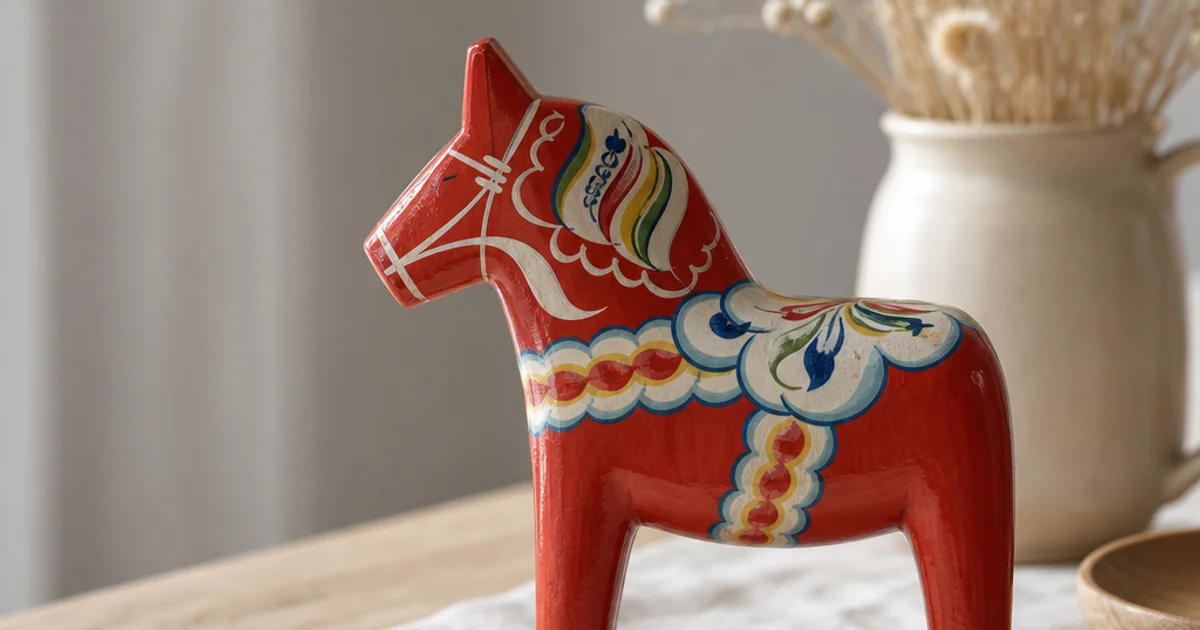
It was a painter from the village of Risa, Stikå Erik Hansson, who in the nineteenth century perfected the technique that still defines the Dala horse today: loading a single brush with two colours at once, so that each stroke lays down a petal that shades light to dark in one confident sweep. Look closely at an authentic dalahäst and you can still see that two-tone stroke in every flower.
Why red? The colour of copper and country
Ask anyone to picture a Dala horse and they will picture it red — a warm, earthy orange-red. That colour is no accident. It is the same pigment that paints the wooden cottages of the Swedish countryside: Falu red (falu rödfärg), a paint whose ochre comes from the great copper mine at Falun, in the heart of Dalarna.
The story goes that a soldier billeted with a Dalarna family carved a horse from scrap wood and painted it with the bright red pigment that the nearby mine made cheap and plentiful. Whatever the precise origin, red became the classic ground for the horse, with the kurbits flowers picked out over it in white, blue, green, and yellow. Other colours — blue, black, white — exist, but the red horse is the one the world recognises.
The leap from toy to national symbol
For most of its life the Dala horse was a local thing: a Dalarna craft, a child's plaything, a souvenir of the province. What turned it into a symbol of an entire nation was a single, spectacular moment on the world stage.
At the 1939 New York World's Fair, Sweden's pavilion was guarded by an enormous Dala horse standing roughly 2.8 metres tall — crafted for the occasion (the work of artist Göte Hennix, produced by NK's workshops in Nyköping). Fairgoers were enchanted. The giant red horse became one of the most photographed sights of the exhibition, and in the year that followed, some 20,000 Dala horses were shipped across the Atlantic to meet the new demand.
In that instant the dalahäst stopped being merely a regional curiosity. It became shorthand for Sweden itself — for craftsmanship, for honesty of material, for a certain handmade warmth.
Still carved in Nusnäs
Remarkably, the heart of Dala horse production never moved. To this day the village of Nusnäs, on the shore of Lake Siljan, is where the genuine article is made — and two family workshops carry the tradition.
The elder is Grannas A. Olssons Hemslöjd, founded in 1922, the oldest company still making Dala horses; the brothers Nils and Jannes Olsson started their own workshop, today's Nils Olsson Hemslöjd, in 1928. In both, the process remains stubbornly, beautifully analogue: slow-grown pine is cut and carved (much of the shaping still done by hand and eye), dipped in primer, sanded, painted its ground colour, and finally given its kurbits flowers by a painter wielding that two-coloured brush. A stamp on the belly marks each one as the real thing.
A small horse with a long meaning
Today the Dala horse is everywhere — on flags and football kits, in design museums, on kitchen shelves from Stockholm to Seattle. It has been reproduced, abstracted, and turned into everything from earrings to road signs. But the original meaning still holds: it is an emblem of patience and care, of long winters turned into something lovely, of a craft handed down through generations rather than stamped out by machine.
At A Swedish Affair, that is exactly why we love it. The Dala horses and Scandinavian gifts we carry are chosen in the same spirit the woodcutters carved them — made to be kept, to be given, and to carry a little of Sweden's warmth into the rooms where they stand.