Santa Lucia: Sweden’s Festival of Light on the Longest Night
August 21, 2026 · Sweden's Finest
In the darkest week of the Swedish year, when the sun rises grudgingly at nine and has given up again by three, the country does something quietly extraordinary. Before dawn on the thirteenth of December, a girl in a white gown walks slowly into a darkened room with a crown of burning candles on her head, and begins to sing. Behind her come others, each carrying a single flame. This is Lucia — Luciadagen — and for Swedes it is the moment the long night finally turns.
The saint, and the longest night
Lucia herself was not Swedish at all. She was Lucia of Syracuse, a young Sicilian killed for her faith in the early fourth century, during the persecutions under Diocletian. Legend says she carried food to Christians hiding in the catacombs and wore a wreath of candles on her head so that her hands stayed free to carry the baskets. Her name comes from the Latin lux — light — which is either a remarkable coincidence or the reason her story attached itself to this day so stubbornly.
Because in Sweden, the thirteenth of December was already the darkest night of the year. Under the old Julian calendar it fell at the winter solstice, and the long night before the turning had a character all its own. Folklore called it Lussinatta, and it was not a cosy occasion: this was the night when the supernatural was abroad, when cattle were said to speak, and when a fearsome figure called Lussi rode the sky and came down chimneys after children who had not finished their Christmas preparations. You stayed awake. You kept the fires lit. You ate well, because the night was long.
When the calendars were reformed and the solstice slid later, the date stayed put. What was left was a midwinter festival of light with a saint's name attached to it — and the older, stranger memory of the longest night humming underneath.
A procession of light
The Lucia we see today is a procession, and it is beautiful in a way photographs never quite manage.
At its head walks Lucia, in a white gown with a red sash — white for purity, red for the martyrdom — wearing a crown of lingonberry greenery set with candles. Behind her come her attendants, the tärnor, in white with candles in their hands. Then the star boys, the stjärngossar, in tall white cone-shaped hats scattered with stars, carrying star-tipped wands. In school and family processions the ranks often swell further, with children dressed as gingerbread men and small tomtar bringing up the rear, which is exactly as charming as it sounds.
Processions like this were recorded in Sweden as early as the eighteenth century, beginning as a private custom in manor houses. It was really the twentieth century that made Lucia national — newspaper competitions to crown a city Lucia, schools adopting the procession, and eventually a televised concert that a large share of the country still watches. Today there are Lucias in churches, schools, hospitals, offices and village halls.
The candles, it should be said, are mostly electric now. A crown of open flames worn on a child's head is precisely as hazardous as it sounds, and Swedish practicality won out some decades ago — which is why a modern Lucia crown takes small bulbs, and why sensible households keep spare bulbs in the drawer with the Christmas things.
"Sankta Lucia"
The procession sings, and it sings one song above all others.
The melody will surprise you: it is Neapolitan. "Santa Lucia" was an Italian boatman's song, published in the nineteenth century, celebrating a waterfront district of Naples — about as far from a dark Swedish morning as it is possible to get. Sweden borrowed the tune and gave it entirely new words, and the best-known Swedish version opens Natten går tunga fjät — "the night walks with heavy steps." It is a song about darkness giving way, and sung by children's voices in an unlit room at seven in the morning, it does something to the back of the neck.
Saffron, ginger, and glögg
Lucia is also, unmistakably, a smell: saffron.
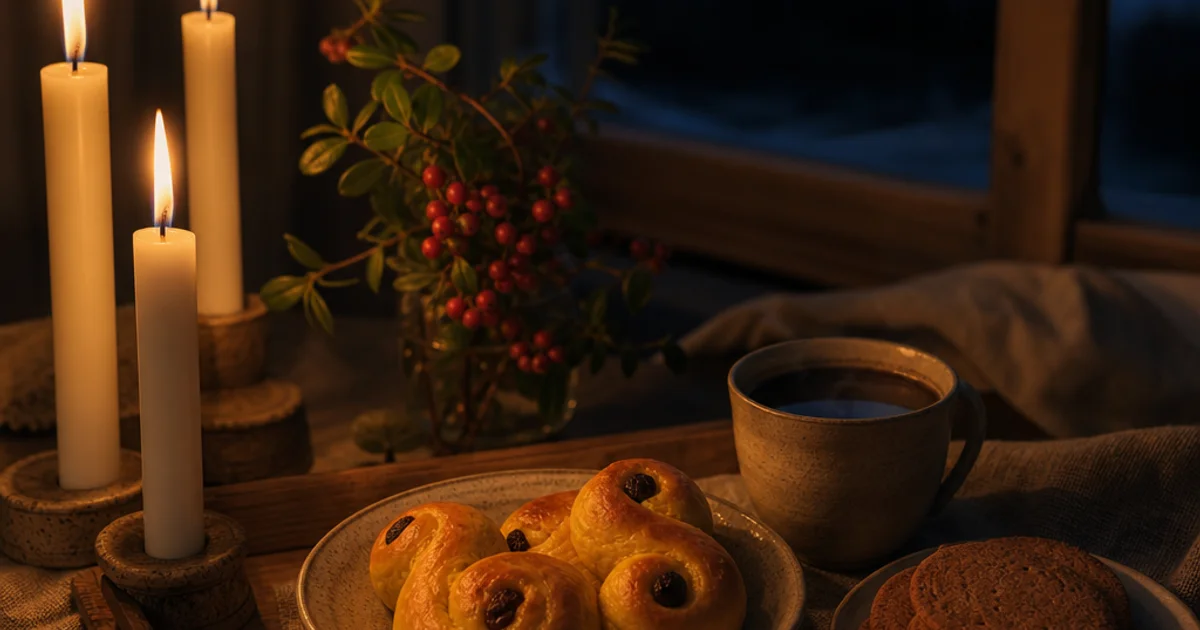
The day belongs to lussekatter — Lucia buns — deep gold with saffron, rolled and curled into a tight S with a dark raisin pressed into each spiral. The shape is old and its meaning is debated; the name translates as something close to "Lucia cats," and older, darker readings connect the buns to the devil in cat form, tamed and made harmless by the saffron's light. What matters at the table is that they are eaten warm, in quantity, and that the saffron is not skimped.
Alongside them come pepparkakor, the thin, snapping ginger biscuits that fill Swedish houses from December onward — spiced with ginger, cinnamon, cloves and cardamom, rolled to the thickness of a coin. A tin of proper Swedish ginger snaps is the shortcut if you are not baking, and there is a well-loved superstition worth knowing: place a pepparkaka in your palm, make a wish, and press the centre with a finger. If it breaks in three, the wish comes true.
And to drink, glögg — mulled and spiced, poured over blanched almonds and raisins waiting in the bottom of the cup, served hot to hands that have come in from the cold.
Lucia at home
For all its public pageantry, Lucia began as something domestic, and in many families it still is. The eldest daughter traditionally rises before the household, dresses in white, and carries coffee and a tray of saffron buns to her parents' bedside, singing as she comes. Everyone else stays gratefully in bed and pretends to be surprised.
That is the version worth stealing, wherever you live. It requires no procession and no choir — only somebody willing to get up in the dark, a tray worth carrying, and something warm on it. If you would like the story first, Lucia Morning in Sweden tells it for children in exactly the right register.
Bringing Lucia into your home
Lucia is the hinge of the Swedish Christmas: everything before it is preparation, and everything after it is the season proper. It is also, for a great many Swedish-Americans, the tradition that carries the most feeling — the one remembered from a grandmother's kitchen, or a church hall in Minnesota, long after the language has faded.
If you are keeping it this year, a few things help. A wooden Lucia candleholder or the white metal procession candle holder puts real light on the table where it belongs. A ceramic Lucia ornament or a Lucia Procession tile keeps her up all season. And for the table itself there are Lucia napkins, a linen place mat, and a mug for the coffee that goes with the buns.
At A Swedish Affair we have been bringing these things over from Sweden since 1984, and Lucia is the part of the year we look forward to most. However you keep the thirteenth — a full procession, or one person awake before dawn with a tray and a candle — may the light in your house be warm and the saffron be generous.
Glad Lucia!